
Finding agreement: Functional magnetic resonance imaging hyperscanning reveals that mental state space exploration facilitates opinion alignment.
Journal of Personality and Social Psychology, 2026. DOI
Department of Psychological and Brain Sciences | Texas A&M University
We are recruiting for Fall 2027 →
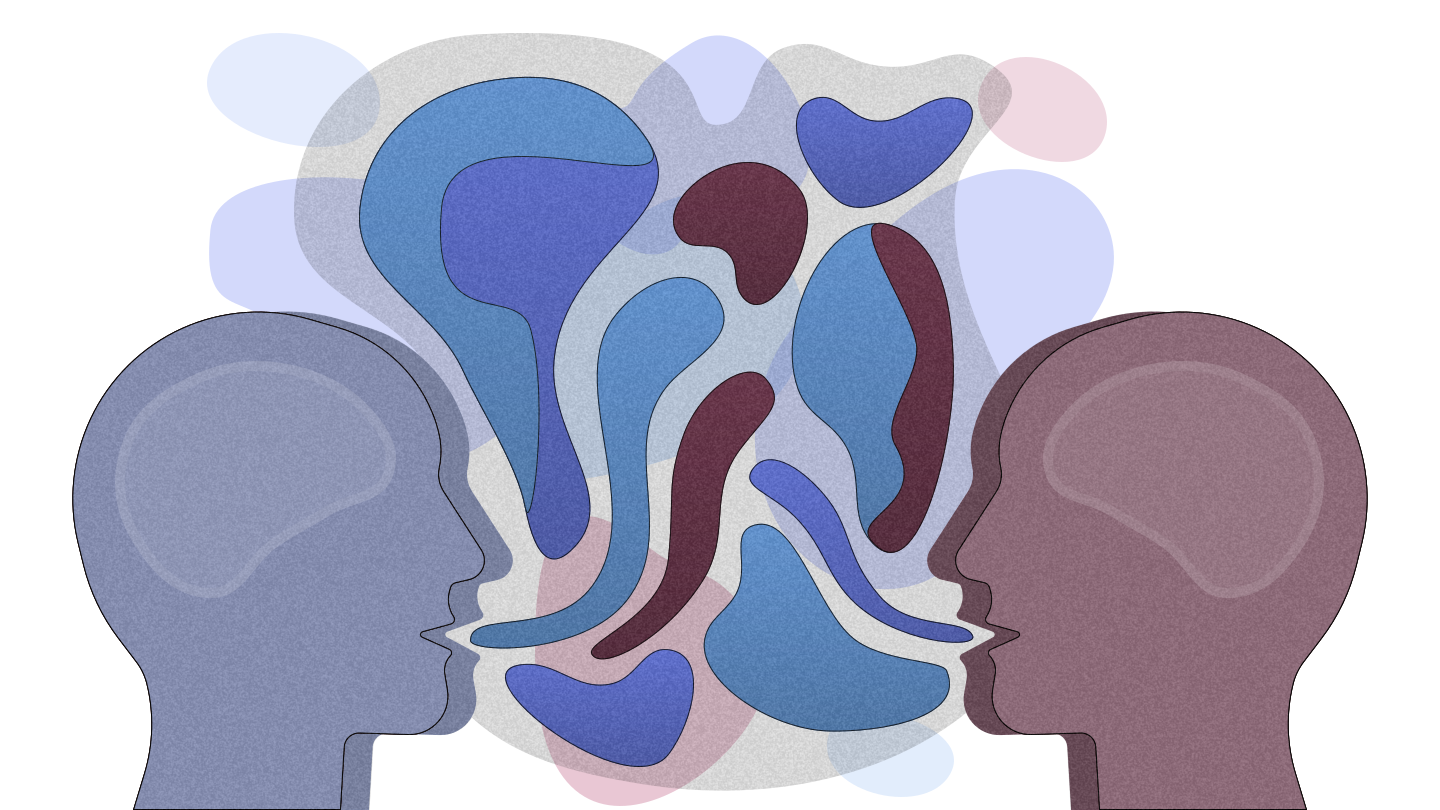
How do minds wander in new directions in conversation? How do we negotiate meaning and compromise when our paths diverge? And what happens when one of those minds belongs to a machine?
We study how people explore ideas, align opinions, and resolve conflict through conversation. Our work integrates fMRI hyperscanning, natural language processing, and computational modeling to understand how human (or artifical) minds become coupled in naturalistic interactions.
We are also extending this work to examine how conversation dynamics change across different internal states, social contexts, and clinical populations. For example, we are interested in how substances such as alcohol may alter interpersonal alignment and exploration; how contexts such as dating shape the way people coordinate, disclose, and evaluate one another; and how these dynamics unfold in populations characterized by social difficulties, such as individuals with social anxiety.

Principal Investigator
Sebastian currently explores how two minds form a social connection, build consensus and resolve conflict during naturalistic social interactions. Previously, at the Netherlands Institute for Neuroscience, he investigated moral conflict resolution through reinforcement learning models, shedding light on how we learn to navigate ethical dilemmas. He earned his PhD in Neuroeconomics at the Erasmus University in Rotterdam, where he combined neuroimaging, machine learning, and behavioral experiments to uncover the neurocognitive mechanisms driving (dis)honest decision-making.
Under construction! We're building our team of students, postdocs, and collaborators.
Journal of Personality and Social Psychology, 2026. DOI
Nature Communications, 2024. DOI
In A. Fishbach, N. Liberman & F. Kentaro (Eds.), The Psychological Quest of Meaning., 2025. DOI
Neuroimage, 2023. DOI
Trends in Cognitive Sciences, 2022. DOI
Proceedings of the National Academy of Sciences, 2020. DOI
Our lab develops and shares open tools to accelerate social neuroscience research, especially for analyzing naturalistic, multi-brain data. These resources are continually evolving as we expand our methods for coupled-mind and conversation-based studies.
A Python toolbox to streamline preprocessing and alignment of hyperscanning data across participants. It provides flexible pipelines for synchronizing multi-subject fMRI, handling timing offsets, and preparing data for inter-brain analyses. Hypline will continue to expand with additional modules for dual-scanner and conversation-based datasets.
A hands-on Google Colab tutorial introducing decoding analyses in fMRI. Learn how to implement pattern-based prediction, visualize representational geometry, and interpret model performance using real neuroimaging data.
An interactive tutorial for EEG analysis demonstrating preprocessing and time-frequency decoding in Python. Walk through each step — from raw data to power spectra — to understand the temporal dynamics of neural representations in cognitive tasks.
We are recruiting graduate students and undergraduate researchers excited about social neuroscience, naturalistic conversation, and computational methods. Please read our recent publications and come prepared to discuss how you'd build on them.
All applications must be submitted through the Texas A&M application portal .
Deadlines are typically in December — start early, and reach out if you’re curious about fit. We especially welcome applicants interested in neural coupling, conversational dynamics, and human–AI interaction.
